

EXPLORE THE PRAXIS LEADERSHIP SYSTEM AND EPI FRAMEWORK
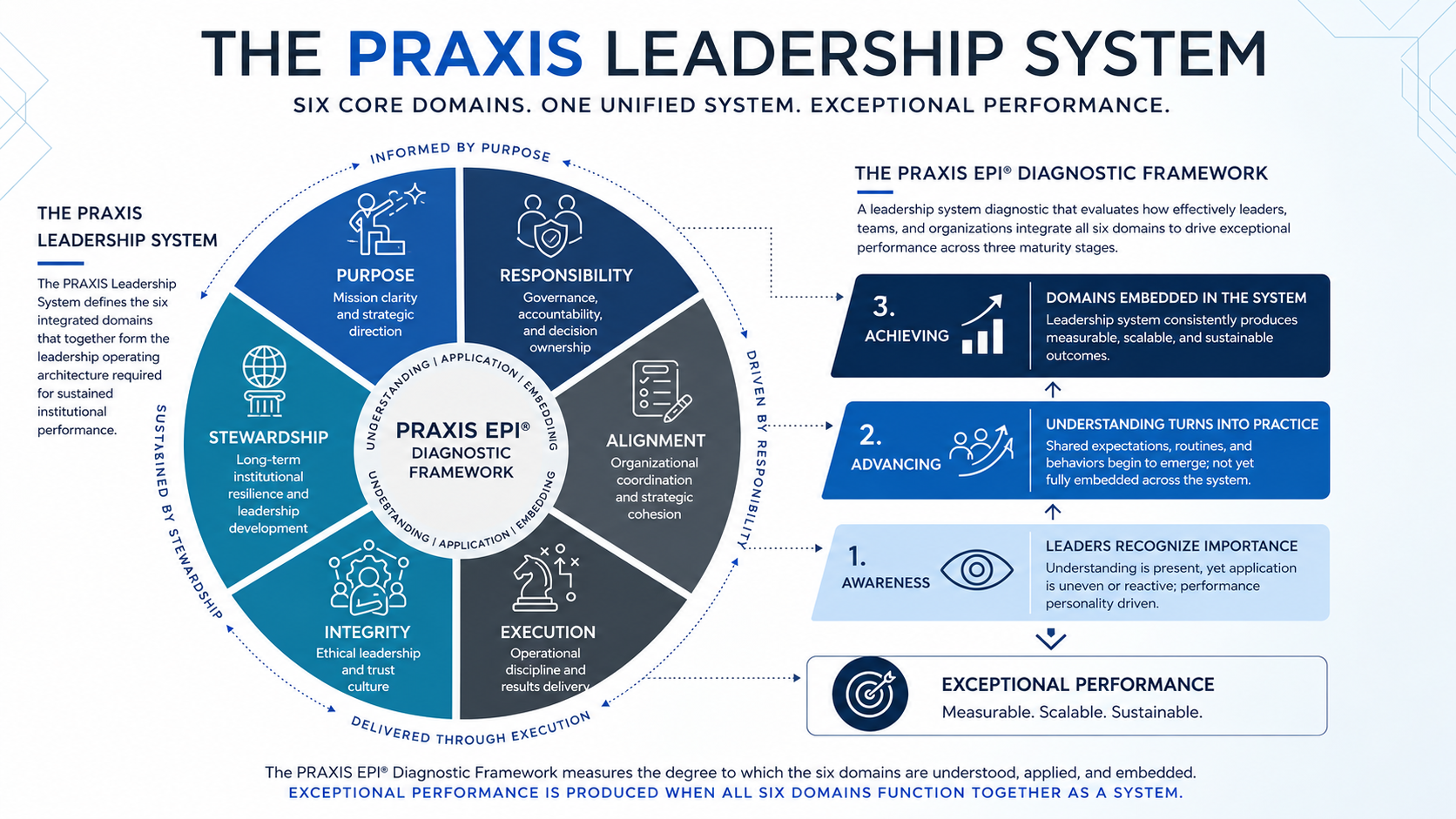
Scroll through each leadership domain and select the Indicator for Awareness, Achieving, and Advancing to discover how to mature into exceptional performance. Take our survey in the Research tab and get your personalized individual score and recommendations.
The developmental stage of clarity. The leader, team, or organization begins to identify gaps, understand expectations, define foundational structures, and build intentionality around what leadership requires at each level.
The execution stage. Leadership systems produce measurable, repeatable outcomes. Discipline, accountability, and operational consistency define this level. The organization can consistently deliver what it intends.
Systemic maturity. Leadership becomes adaptive, regenerative, and future-shaping. The organization learns faster than its environment changes and builds institutions that outlast individuals. Performance is self-sustaining through governance, not heroic effort.
The EPI® measures organizational leadership maturity across all six PRAXIS domains. Score each domain by selecting the maturity level that best describes your current state. The instrument produces both a total score and a domain profile — because the same total can represent fundamentally different organizational realities.
Score based on the organizational level most relevant to your current context: Individual leader capacity, Team collective capability, or Organizational institutional performance. Each lens applies the same six domains and three maturity levels — producing three distinct but related profiles from one framework.
Each of the six domain chapters maps to three newsletter articles — one per maturity level — producing an 18-article domain series. Part I yields 2 foundational articles (Article 11 already published as Chapter 1). Part III yields 3 capstone articles. Total: 23 articles with a coherent developmental arc that constructs the book chapter by chapter in public.
Each stage feeds the next. The sequence is not arbitrary — earlier stages produce the intellectual capital and market credibility that make later stages viable. Attempting to launch the diagnostic before the IP architecture is resolved, or the forum before the book creates the audience, inverts the value chain.
Resolve the Integrity domain decision. Name and define the Tri-Lens Architecture™. Finalize the 6×3×3 matrix with observable behavioral indicators per cell. Lock the EPI® scoring instrument and tier logic. No subsequent stage is stable until this is complete.
Integrity domain resolved ✓Tri-Lens Architecture™ named ✓Tier logic recalibrated ✓Level III risk added ✓Articles 12–23 build the book in public, establish PRAXIS thought leadership, and test intellectual IP with a real audience before the book is written. Each article validates a domain chapter and builds the subscriber base that becomes the book's first audience. Article 11 (already published) is Chapter 1.
Article 11 = Chapter 1 (published)Articles 12–23 = Chapters 2–11One domain per three articlesThe 23 articles provide the intellectual material. The book integrates them into a coherent argument with new synthesis, case studies, and the full EPI® framework. Publishing creates the primary credibility anchor for all advisory and diagnostic products that follow.
11-chapter architecture confirmedArticle series provides draft materialThe EPI® becomes a standalone assessment product anchored by the book and the IP architecture. Organizations complete the diagnostic to receive a domain profile, maturity tier, and prioritized development roadmap. This is the entry point into Praxis advisory engagements.
Domain profile (radar/hexagon)Total score + tier interpretationPrioritized development roadmapAdvisory engagement entry pointThe EPI® results drive workshop design — participants bring their domain scores and work through domain-specific development protocols. Each of the six domains has a half-day module. The Tri-Lens Architecture™ enables separate workshops for individual leaders, leadership teams, and organizational governance bodies.
Six domain modulesThree lens formats per moduleEPI® results as workshop inputsThe Forum is the community product — a curated peer network for leaders progressing through the PRAXIS maturity levels. Membership is anchored by the book, the diagnostic, and the workshop experience. The newsletter subscriber base, built through Stage 2, is the founding audience.
Newsletter subscribers = founding audienceBook = credibility anchorEPI® = membership qualification frameworkDecision: Integrity is restored as the I domain. It is the ethical anchor and the primary IP differentiator of the PRAXIS system — without it as a named domain, PRAXIS becomes indistinguishable from generic leadership frameworks. Integration (learning systems, adaptive intelligence, knowledge synthesis) is embedded as a cross-cutting capability within the Advancing level of every domain rather than standing as its own domain. This preserves the ethical architecture while honoring the learning and adaptation insight. Every domain at Level III now explicitly includes how integration of knowledge and adaptation of the system expresses that domain at its highest maturity.
Decision: The correct ascending sequence is Awareness → Achieving → Advancing. The recast document's opening section misstated this as "Awareness → Achieving → Advancing" in the header but described the same correct sequence in the body. This has been made consistent throughout every section of the framework.
Decision: With 6 domains × 3 points maximum = 18 total possible, the four tiers are now: 6–9 Emerging (4 points), 10–12 Performing (3 points), 13–15 Integrated (3 points), 16–18 Transformational (3 points). Balanced distribution. The diagnostic also produces a domain profile alongside the total score, because two organizations with the same total score but different domain distributions require different interventions.
Decision: Every maturity level now has its failure mode explicitly named. Level III risk: advancing without renewal regresses into complacency or institutional arrogance. Systems that stop questioning their own foundations eventually calcify — mistaking past success for permanent readiness. The most dangerous failure mode at this level is the illusion of invulnerability.
Decision: Part III is now the diagnostic and transformation application section: Chapter 9 (EPI® assessment and domain profiles), Chapter 10 (designing transformation roadmaps), Chapter 11 (building governance that sustains advancement). The three maturity levels are no longer repeated as dedicated chapters — they are embedded within every domain chapter in Part II, where they belong.
Decision: The individual / team / organization lens structure is named the PRAXIS Tri-Lens Architecture™. This is one of the framework's most distinctive features — applying the same six-domain, three-level maturity model simultaneously at all three organizational levels. Most leadership frameworks address one level. PRAXIS Tri-Lens addresses all three from the same architecture, enabling leadership development, team effectiveness, and organizational governance advisory to operate from a single proprietary methodology.
Decision: Each of the 54 matrix cells (6 domains × 3 levels × 3 lenses) now contains: a current state description, 3–4 observable behavioral signals, and a coaching or governance application. This converts the framework from a conceptual reference into a functional diagnostic instrument where assessors can confirm or disconfirm specific observable behaviors rather than relying solely on self-reported subjective assessment.
Decision: Six-stage product roadmap defined with explicit sequencing logic: (1) Finalize IP architecture, (2) Publish 23-article series, (3) Publish book, (4) Launch EPI® diagnostic instrument, (5) Build workshop curriculum, (6) Launch PRAXIS Leadership Forum. Each stage feeds the next. The newsletter subscriber base built in Stage 2 becomes the Forum founding audience in Stage 6. Article 11 (already published) maps to Chapter 1, making the build-in-public strategy already underway.